


Submersible drainage pumps for pumping out flooded basements, lift shafts, sumps, trenches, swimming pools and water tanks. Our range runs from a 550W drainage pump at R1,600 through the cast-iron WSD series from 0.18kW to 3.7kW, in single-phase 220V and three-phase 380V, most with a float switch for automatic operation. For water with sewage or large solids, see our sewage pumps; for a wider range of submersible pumps including dam pontoons, see the main category.
- Clean or dirty water? Rainwater, seepage and pool water suit any drainage pump. Mud, sand and leaves need an open-channel or vortex impeller that will not clog, which is what the WSD range is built for.
- How much and how fast? A domestic sump or a flooded room is handled by a 0.18–0.55kW pump. Building sites, trenches and big basements need 0.75kW and up, with 50mm or larger outlets to move serious volume.
- How high? Add the depth of the pit to the height of the discharge point and a little for the hose. Check that total on the pump curve; the “max head” figure is where flow drops to zero.
- Automatic or manual? A float switch lets the pump look after a sump on its own. For emptying a pool or tank by hand, a manual pump that can be run down to a few centimetres is more useful.
- 220V or 380V? Up to 2.2kW you can have either; larger pumps are three-phase.
Never let a drainage pump run dry for more than a few seconds, keep the strainer clear, and use a lay-flat hose or rigid pipe no smaller than the pump outlet.
Can I use a drainage pump to empty my swimming pool?
Yes, that is one of the most common uses. A 0.18–0.55kW pump empties an average pool in about half a day. Stop before the pump runs dry, and never empty a fibreglass pool completely without checking with the installer.
What is the difference between a drainage pump and a sewage pump?
A drainage pump passes small solids such as sand and leaves. A sewage pump has a much larger free passage for rags, paper and waste. Using a drainage pump on sewage will block it.
How deep can the pump be submerged?
The WSD range is rated for up to 10 m of water above the pump, which covers sumps, tanks and pools. For boreholes you need a multistage borehole pump instead.
Do you deliver nationwide?
Yes. Drainage pumps are couriered across South Africa. For help choosing, WhatsApp 061 744 1001.
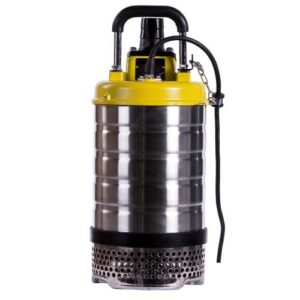

Drainage Pumps


Choosing a drainage pump
Drainage pumps handle clean to slightly dirty water with small particles. For sewage or water with larger solids, choose a sewage pump instead.
- 0.18kW to 0.55kW – emptying pools, water features, rainwater sumps and small tanks
- 0.75kW to 1.5kW – flooded basements and building sites, or lifting water higher
- 2.2kW to 3.7kW – high flows for construction, farms and industrial sumps (the 3kW and 3.7kW models need three-phase 380V power)
Each pump lists its maximum head (lift height) and flow. Make sure it can lift the water from the bottom of the sump to where it must go, plus the friction in the hose. Our 220V models have a built-in float switch, so they start and stop on their own. For 380V models, add a separate float switch. Don't let a drainage pump run dry for long.
Need help? WhatsApp or call 061 744 1001. We deliver nationwide.